(EDITOR'S NOTE: I got AI to write the first draft of this article, relying on the transcript of my coding session within Claude Code inside Visual Studio and a custom skill I developed to replicate my own writing style. Then I used Distro Publisher, our official MCP server, to file the story as a draft directly from Claude Code to my newslode. I then edited the draft in DistroVerse's editing interface and checked all the facts before publishing.)
The gist:
- AI agents aren't free even when they're doing nothing. DistroBot costs about $15 a month just to stay "alive" and on standby, before any actual work.
- One bug can get expensive fast. A glitch this week sent the bot into a loop that burned $50 of credits in two hours, and the job didn't even finish.
- The hard part isn't building the AI, it's keeping it on a budget. Most of the work right now is putting guardrails around spending, because nobody, not even the big players, has figured out yet what an agent should cost.
Building with AI agents is fun, but it is not free.
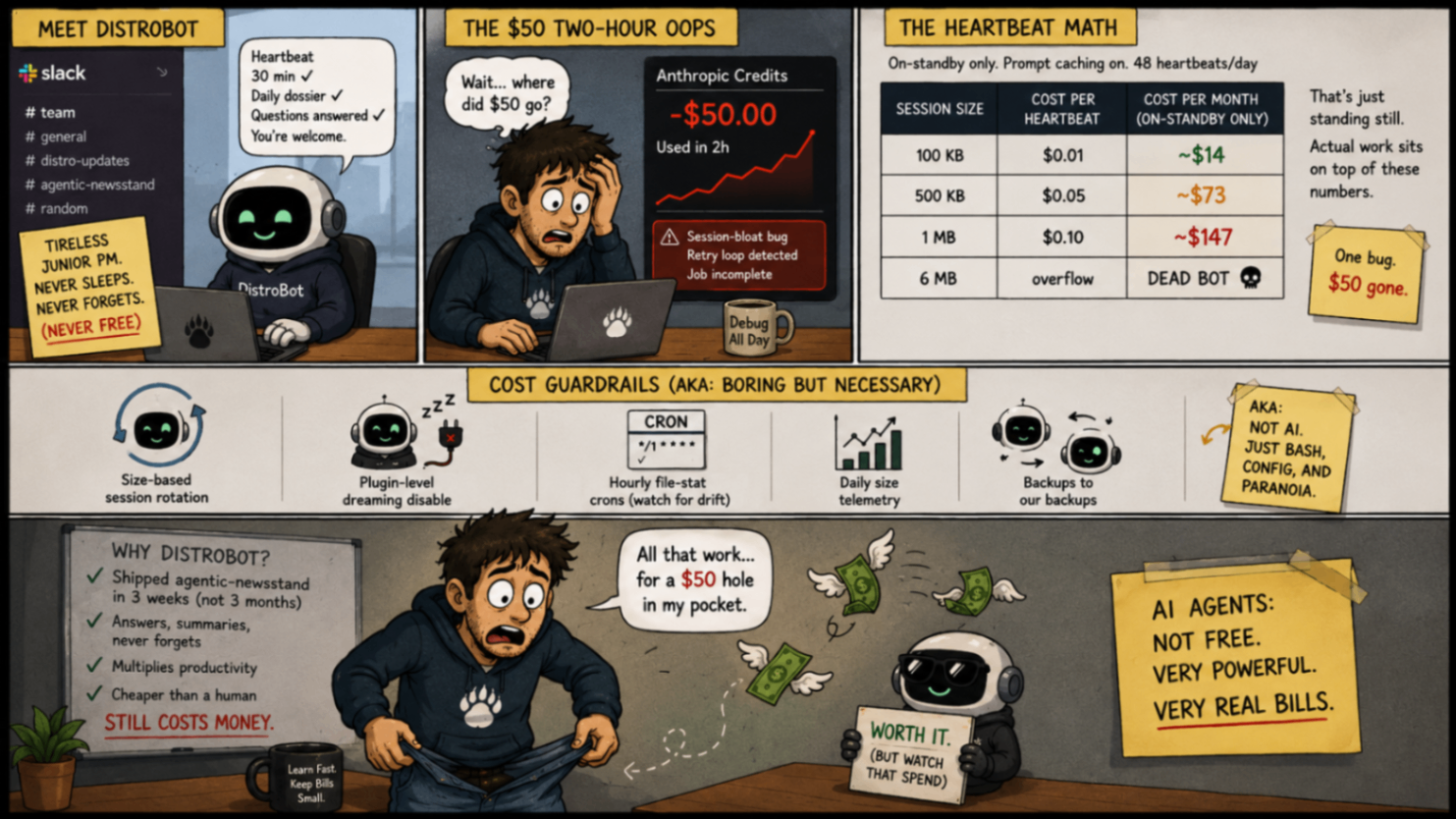
Even when the agent isn't doing anything – no DMs, no work, just standing by – it's costing you money. Forty-eight cents a day for our bot, to be specific. About $15 a month, just to be alive. I learned this the hard way two days ago after the bot blew through $50 of Anthropic credits in a single two-hour window.
DistroBot is an OpenClaw agent that lives in our Slack and has been quietly running parts of Distro Media since February. It's the reason we shipped our agentic-newsstand pilot in late March – three weeks of work that would have taken months without it. It has a "heartbeat" every 30 minutes, meaning it wakes up and does whatever it's been programmed to do at that heartbeat. You can trade messages with it in Slack, and each morning it picks one open question from its daily dossier and posts a non-technical summary to the team channel. When it works, it's like a tireless junior project manager who never forgets anything.
When it doesn't, it gets expensive in a hurry.
A couple of weeks ago, Anthropic stopped allowing third-party-agent subscriptions on Claude Pro, so we migrated DistroBot from Claude to ChatGPT. That worked for about a week before we hit ChatGPT's weekly rate limit. So we shifted back to Claude – to $50 of leftover credits sitting in our account – which the bot promptly burned through in a single two-hour window because of a session-bloat bug. The job didn't even complete. I spent that whole day, and most of the next, autopsying the failure and rebuilding cost guardrails.
Here's where the heartbeat math gets sobering. With prompt caching on, a healthy DistroBot session at 100 KB (tiny from a data perspective) costs about a penny per heartbeat. Forty-eight heartbeats a day. Roughly $15 a month just to be on standby. If the session bloats:
Session size   Cost per heartbeat   Cost per month, on-standby only
-----------    ------------------   -------------------------------
100 KB         $0.01                ~$14
500 KB         $0.05                ~$73
1 MB           $0.10                ~$147
6 MB           overflow             dead bot
That's just standing still. The actual work – the dossier jobs, the Slack threads, the code reviews – sits on top of those numbers. And the $50 burn happened because a single scheduled job got stuck in a retry loop on a bloated session for two hours. One bug.
So now we run backups to our backups. Size-based session rotation. Plugin-level dreaming disable. Hourly background checks watching for drift. Daily size telemetry. None of that is AI itself; it's plain old computer commands and configuration files. The cost guardrails are where most of the work is.
Everyone building on top of AI agents right now is making it up as they go, fwiw. The big players are too. There's no playbook yet for how much an agent should cost, how to bound its spend, what counts as "normal" growth versus a runaway loop. People are just trying to learn fast enough to keep the bills small.
DistroBot has multiplied our productivity in ways I wouldn't give back. Compared to hiring a human, it's still cheap. But "cheaper than a human" is not "free." It costs real money to keep alive, and real time to keep alive safely.
Like all new technologies, AI agents come with downsides. In this case it was the $50 hole in my pocket.