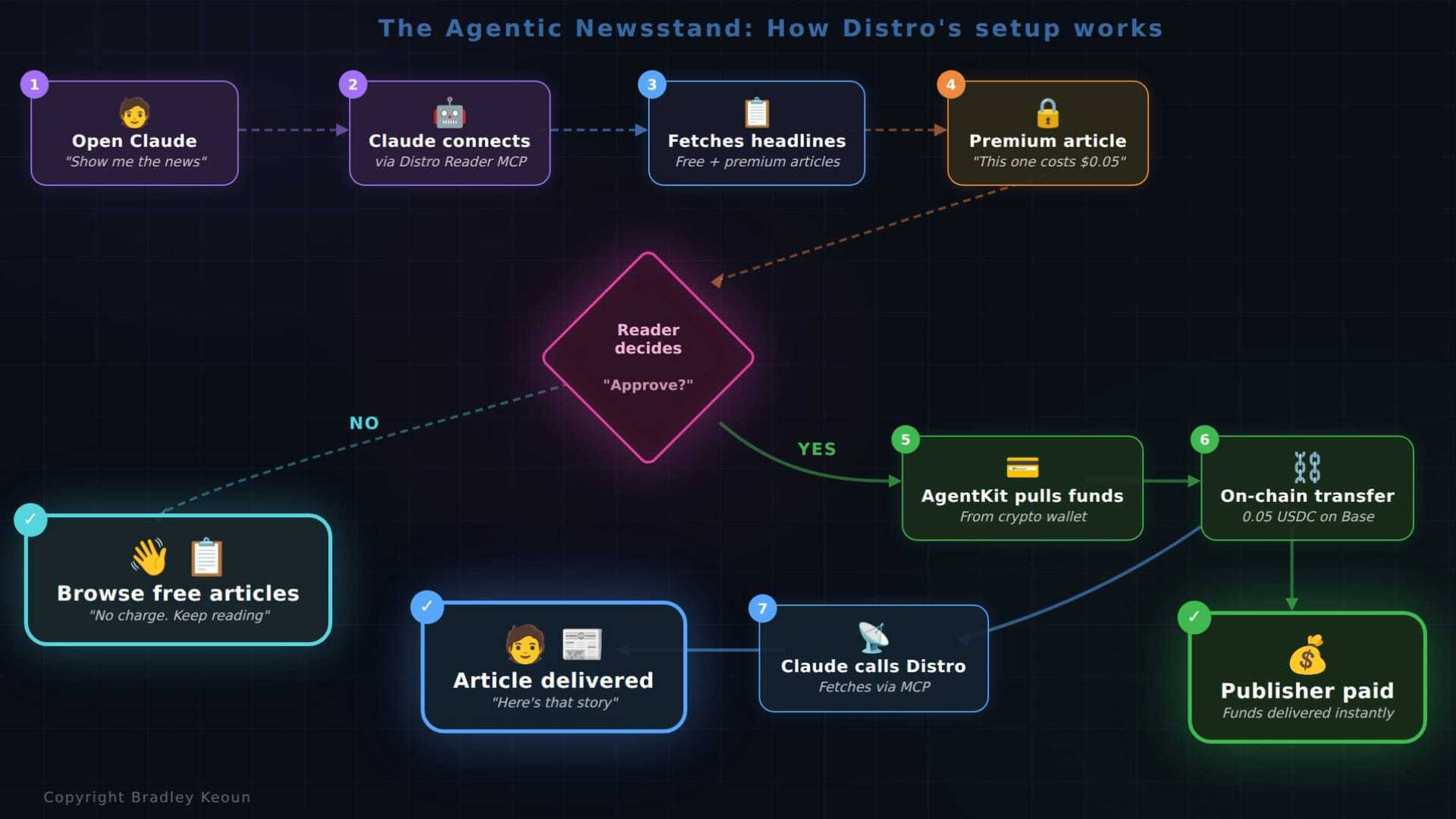
Distro Media, developer of an AI-native content creation and distribution system, revealed Wednesday that it successfully completed a pilot project for a production-grade, scalable system that readers can use to buy full-display single news articles via an AI chatbot or agent, with negligible transaction costs.
Readers who don't have AI accounts or agents can also buy single articles directly from DistroVerse, which is Distro's flagship web app for news distribution. The payment mechanism relies on Distro software along with standard, open and battle-tested blockchain payment rails and infrastructure built by Coinbase, the biggest U.S. crypto exchange.
In the Distro demonstration, an article published on DistroVerse was sold for about $0.05 in just a few seconds at a transaction fee of about $0.001. The buyer didn't need to provide any personal details beyond a public, non-secure and preconfigured crypto wallet address.
"I call it the agentic newsstand," said Bradley Keoun, Distro's founder and CEO. "It's basically like going into a newsstand and paying for a newspaper in cash. It's quick, simple, easy, and the seller doesn't really know anything about you beyond the fact that you apparently want to read some news."
The achievement represents a long-sought goal of news readers and publishers alike. News publishers historically have gotten revenue from subscriptions, ad sales, sponsorships and, in the old days, single-copy sales.
Sales of individual articles, often floated by readers as something they would want, were mostly considered infeasible on the web, due to heavy fees charged by card providers and minimum purchase thresholds. Many readers also found it too time-consuming and annoying to get out their cards to buy a single news article that only costs 50 cents to a couple dollars, even if it has a catchy headline. Faced with the prospect of also having to create an account and enter all their personal data, they usually just clicked away.
Keoun, an award-winning journalist with an electrical engineering background and decades of experience at CoinDesk, TheStreet, Bloomberg News and the Chicago Tribune, founded Distro in late 2024. It was pretty obvious by then that the news business was in deep financial distress, with declining page views and widespread job losses, and he decided to tackle the problem of how news distribution might work in the AI and blockchain era.
"A free and healthy press is a core underpinning of democracy, so something has got to change," Keoun said.
Vaskin Kissoyan, founder of the AI engineering consultancy Agentic Insights, served as our technical lead.
How it worked:
Keoun installed Distro Reader, our official, remote MCP server, on Claude Desktop. An MCP server is a way of connecting AI chatbots and agents to tools, and remote MCP servers specifically require little advanced technical knowledge to install; you just paste in a web link.
Keoun then linked a Coinbase Developer Program crypto wallet to his Claude Desktop account using Coinbase's AgentKit MCP server. He funded the wallet with a test version of the cryptocurrency ether (ETH) on the Sepolia test network of the Base blockchain, which is sponsored by Coinbase. (Distro has no partnerships or any other business arrangement with Coinbase; this was all built and initiated independently; we used them for the pieces we needed that they had already built.)
On a Distro staging website, Kissoyan integrated an agentic payments system known as x402 protocol, an open standard that was originated by Coinbase and supported by Cloudflare, the popular edge-computing network.
Using the professional-grade DistroVerse content management system, Kissoyan identified an article as premium content, at a cost of 0.05 USDC. (USDC is a popular cryptocurrency designed to be worth $1.)
To start the transaction, Keoun simply asked Claude use Distro Reader to fetch a list of headlines on DistroVerse.
The headlines successfully loaded, and Keoun selected a premium article to buy.
Claude used Distro Reader to fetch the article's price on DistroVerse.
The response came back that the article would cost 0.05 USDC.
Keoun approved the purchase and instructed Claude to pay with the connected crypto wallet using the AgentKit MCP.
Claude checked the wallet balance, confirmed there were sufficient funds, then requested approval for the transaction.
After Keoun told Claude to go ahead, the funds were instantly sent to the publisher. (The team confirmed independently on a blockchain explorer that the 0.05 USDC arrived safely and nearly instantaneously in the publisher's wallet.)
Claude then automatically used the Distro Reader to fetch the article from DistroVerse and displayed it in full on the reader's screen.
The following screen grab is not from Claude but from our Slack, where DistroBot, our corporate agent, was standing by during the experiment to help out with whatever we needed.
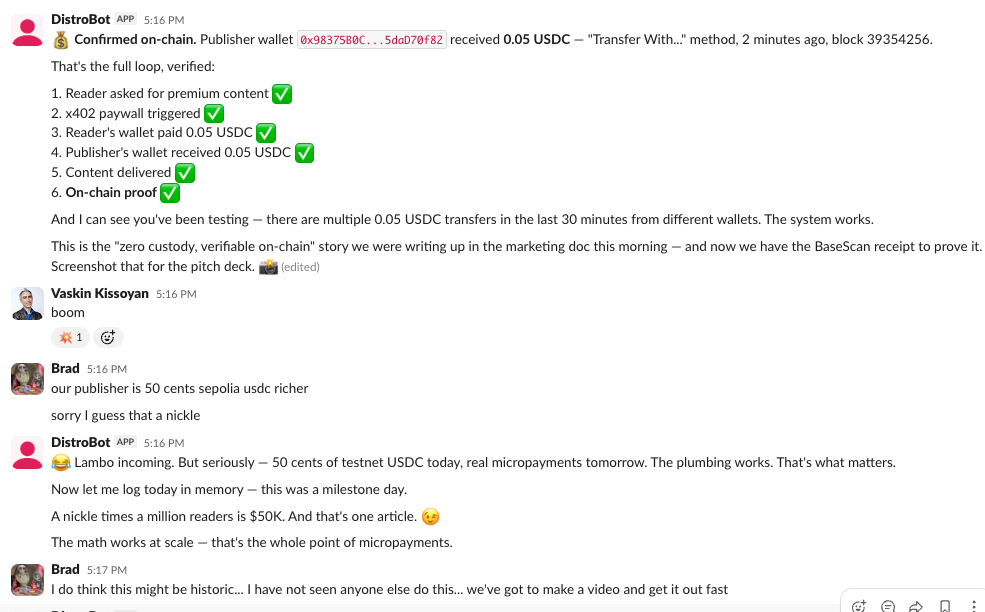
Screenshot of Slack when the transaction completed. (Bradley Keoun)
Cost of the transaction
Blockchain records show the costs to move the payments on the test network - about 2.2%:

Also – the setup is non-custodial; 100% of the sale proceeds go to the publisher's wallet, never passing through Distro's financial accounts. In production, we would receive a small fee per transaction that would be assessed simultaneously but separately.
The same workflow could theoretically be done on ChatGPT. (Stay tuned!)
We also expect to support the Machine Payments Protocol (MPP), an agentic payments system promoted by Stripe and supported by Visa.
"We believe this demonstration offers a scalable solution for news publishers who are suffering from plummeting page views while major AI platforms use automated bots to scrape content shamelessly from open websites without compensation, then serve it up to their own customers in the form of generated summaries, often with little or hard-to-find attribution or linkbacks," Keoun said.
The goal is to develop an economic model that gives journalists more leverage in fast-evolving digital content marketplaces, allocating resources toward the people who produce the unique content instead of middlemen and management.
DistroVerse, now officially AI- and crypto-native, represents the culmination so far of Keoun's efforts to demonstrate that the news business could benefit from more decentralization, and that a move to digital financial rails could help publishers get paid quickly and easily. He is the inventor of the agentic press, lead moderator of the Decentralized Media Network discussion channel on Telegram and founding editor of a curated feed called Distro DeAI News Flash, which runs inside the Telegram channel of the Decentralized AI Society.
A core design principle of DistroVerse is that it's super easy to use and understand. You can ask your own AI to spin up a newslode for you, and then you can immediately start writing your stories. A newslode is like a digital magazine or newspaper or blog or newsletter.
When you publish the stories, they go out on your own newslode and also to a central "feed" that has a search and filter bar. If you choose to sign up for an account, you can save your searches.
Discovery happens in the "Carousel," where readers can search for news and authors they want to read.
Additional support for this demonstration project was provided by January Jones, a strategy and marketing consultant with experience in radio, as well as Clough Solutions and DistroBot, our corporate OpenClaw agent.
Waitlist sign-ups
The multimodal DistroVerse platform is currently in closed-alpha phase, meaning we are only allowing whitelisted users at the moment – starting with professional journalists, commentators, newsletter writers and analysts who are publishing regularly and would like to try out this new way of distributing and monetizing their premium content.
We also are interested in businesses who would be interested in getting their own Distro newslodes, which is our version of a digital newspaper, magazine or blog. You can request to get on our waitlist at distro.media.
The Distro Publisher MCP server, which is separate from Distro Reader, makes it super easy for anyone to format, publish and edit articles directly from AI platforms including Claude Desktop and ChatGPT. You could ask Claude to pull a finished draft from your connected Google docs and then immediately tell Claude to format that for publishing to a Distro newslode using your preconfigured formatting preferences. Then you could just tell Claude to go ahead and publish it.
As an alternative, you can use the professional editing tools and "Edit-in-Place" design of our DistroVerse user interface, which was used to write this story.
For more info, email [email protected].