Visa built a global empire on card networks. Now, in a report co-authored by a Visa expert, the payments giant acknowledges that the ubiquitous and essential system was never designed for the kind of commerce that AI agents are starting to do on their own.
The emerging world of agentic payments will need to handle high-frequency, sub-penny purchases with near-instant confirmation and no pre-existing merchant relationships.
That's a tall order for a card infrastructure initially "purpose-built for human commerce," designed for fewer transactions, larger ticket sizes and merchants established in advance," according to the report. The authors included Lucas Shin, a data & research staffer at the blockchain analytics platform Artemis, alongside Tim Conrad, Visa's on-chain data lead.
Serving the AI agent traffic "creates a need for new layers of architecture above the card layer," the pair wrote.
That the world's largest card network would put in writing underscores the dramatic changes that could take place in global payment technology as AI agents play a greater role in the economy and everyday commerce.
An AI research agent might fire off "hundreds of purchases in an hour, each one a few cents or less, each from a different provider it just discovered," according to the report.
Previous attempts to enable micropayments failed because "card rails carried fixed fees that made sub-dollar commerce unviable," but "a new generation of blockchains has simultaneously lowered the cost and increased the settlement speed of digital payments by orders of magnitude."
The authors assert in a cautionary note for Visa that "the risk of inaction by incumbents is disintermediation," but add that the spoils might go to trusted providers who can adapt quickly.
"The players that combine protocol-native speed with incumbent-grade trust, compliance and distribution are best positioned to define the next generation of agentic payment infrastructure," the report says.
Still a tiny market
For all the architecture rising around it, the segment Visa is conceding remains small. Artemis, which filters raw on-chain totals to strip out what it says is "wash trading" and developer testing, puts x402 at about $15 million in adjusted volume across 109.6 million adjusted transactions since it launched in May 2025.
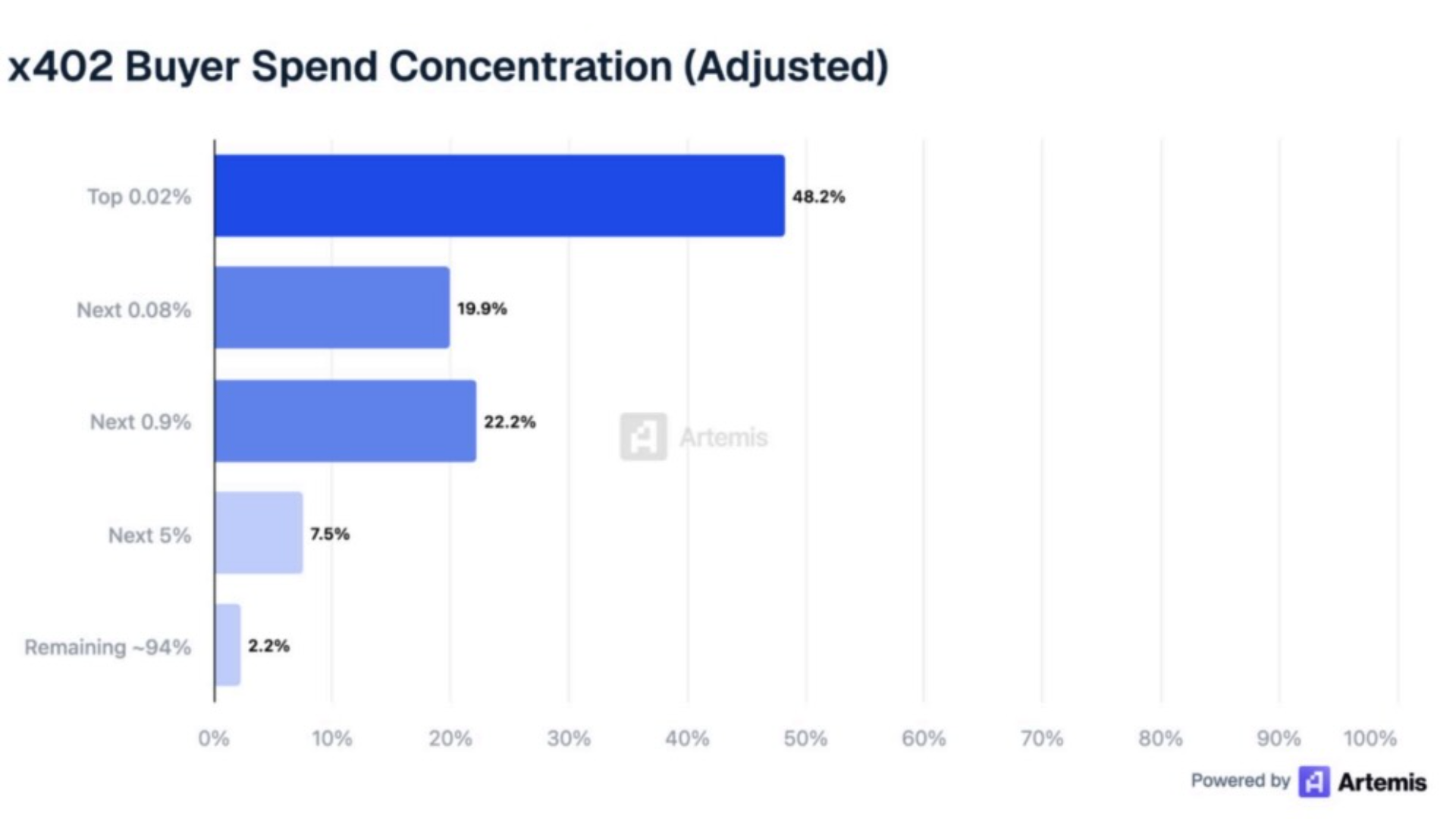
The real activity is also lopsided. Fewer than 0.02% of x402 buyers generate about 48% of adjusted volume, and the top 1% of wallets, roughly 4,000 of them, account for about 90% of volume and half of all transactions.
"This is consistent with an early-stage market in which a relatively small number of sophisticated participants still drive most economic activity," the report reads.
More than 422,000 wallets have bought something, but only about 5,300 have sold anything, a sign the supply of agent-ready services is still thin.
Nearly all of it sits on Base, the Ethereum layer-2 network incubated by Coinbase, which carries roughly 90% of x402's transactions and 93% of its volume. (Coinbase was the original developer of the x402 crypto payments standard.)
Machine Payments Protocol, or MPP, which is shepherded by Stripe and supported by Visa, is dwarfed by comparison. Launched in mid-March 2026, it had processed only about $25,000 in adjusted volume across roughly 115,000 transactions by late April, most of them one-shot "charges" averaging about 17 cents.
(Disclosure noted in the report: the research was commissioned and funded by Visa, which also participates in both protocols it covers, through the x402 Foundation, its card specification for MPP, and its own Trusted Agent Protocol and Intelligent Commerce products. Visa is also among the clients Artemis lists for its analytics.)
(HOW AI WAS USED IN THE PRODUCTION OF THIS PIECE: The first draft of this story was written on Claude Desktop using a custom report-writeup skill, working from the original PDF. I then used Distro Publisher, our MCP server, to file a draft directly to DeAI News on DistroVerse. I checked all the figures against the report before publication.)