(EDITOR'S NOTE: I got AI to write the first draft of this article, relying on the transcript of my coding session within Claude Code inside Visual Studio and a custom skill I developed to replicate my own writing style. Then I used Distro Publisher, our official MCP server, to file the story as a draft directly from Claude Code to my newslode. The AI-generated draft wasn't horrible but I then basically rewrote almost the entire thing using DistroVerse's editing interface.)
Here's something cool: If you're building a feature for your web app in May 2026, you can leapfrog competitors that have been at it for years. I don't say that as a boast; it's more like a realization or acknowledgment of just how good AI coding is. The timing is great to develop a new platform in a crowded space.
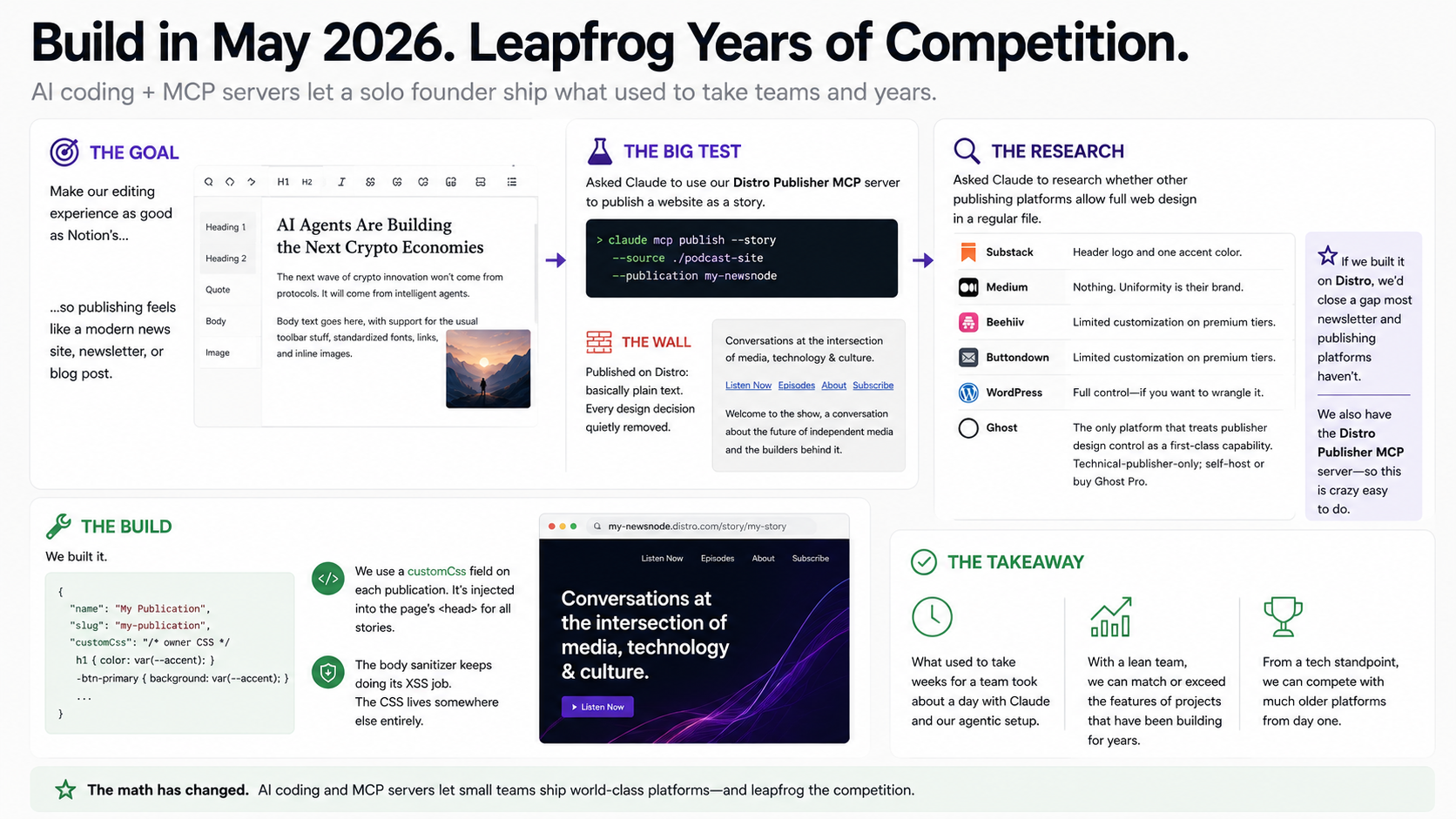
As we were designing DistroVerse over the past six months, we gave it a basic but super-well-appointed editing interface; the goal was to make our editing tool as good as Notion's, which we view as the best on the market, and we mostly got there. But in the end, it's supposed to a news distribution platform, so the visual effect is that of a news site, newsletter or blog post. There's heading, body, pull-quote, a layout consistent across every story – all the usual toolbar stuff including standardized fonts, with the capability to embed links and inline images.
But fancy html? Could you make a random story look as pretty as a complete website with dazzling animations? I wasn't really sure if that would work, or how.
Until suddenly, I needed to figure it out, and I thought I'd give it a try. We are thinking about starting a podcast, and my advisor, January Jones, asked me to spin up a concept website. I asked Claude Code to mock it up, and it came out really cool when I deployed it in the local browser. My friend who's a web designer might have not completely sneered.
So it was time for the big test: I literally just asked Claude to use our Distro Publisher MCP server to publish the web site as a story on a Distro newslode.
The wall
I took a look at published version on Distro. It was basically plain text. Every design decision quietly removed.
As we started to debug, I asked Claude to give me some research on whether other publishing platforms allowed full web design in a regular file.
For most of them, the answer was not much. Substack gives you a header logo and one accent color. Medium gives you nothing; uniformity is their brand. Beehiiv and Buttondown have limited customization on premium tiers. WordPress has full control if you want to wrangle it. Ghost is the only platform in the category that treats publisher design control as a first-class capability — and Ghost is technical-publisher-only; you self-host or buy Ghost Pro.
So if we built it on Distro, we'd close a gap most newsletter and publishing platforms haven't. The extra advantage is that we have the Distro Publisher MCP server – so this is crazy easy to do.
The build
We built it. This part is technical, but we use a customCss field on each publication – a place for the owner to attach their own CSS that gets injected into the page's <head> when any of their stories render. The body sanitizer keeps doing its XSS job. The CSS lives somewhere else entirely.
The takeaway
In the old days, call it a year ago, this would have been a pretty major project. A couple weeks of work for a small team, not to mention all of the internal corporate wrangling for resources and the proverbial greenlight.
With Claude and our agentic setup, it took about a day.
I'm still figuring out what that means. I'm doing this work pretty much solo, supported by an agentic engineer who makes it his job to empower me to do the work without a ton of handholding.
But for any team like ours, starting a platform from scratch, it changes the math. We have zero audience, of course, and trust me – I know as well as anyone how huge that is because I do basically feel alone in the wilderness, pretty much every day.
But from a tech standpoint, we are able to match or exceed the features of projects that have building for years. It is weird.
We wanted to show you what we mean, so here it is below.
We may have gone overboard, but in this case if pressed we might admit it was a conscious choice.
The bar is low to leapfrog competitors with dazzling features.
Building a feature for your web app in May 2026? You can leapfrog competitors that have been at it for years.
I don't say that as a boast. It's more like a realization, or an acknowledgment of just how good AI coding is now. The timing is great to develop a new platform in a crowded space.
Six months of editing tools
As we were designing DistroVerse over the past six months, we built a basic but well-appointed editing interface. Goal: as good as Notion's. We mostly got there.
But in the end, Distro is a news distribution platform. So the visual effect is that of a news site, newsletter, or blog post — heading, body, pull-quote, layout consistent across every story.
But fancy html?
A podcast pitch
I needed to figure it out, and I thought I'd give it a try. We're thinking about starting a podcast, and my advisor, January Jones, asked me to spin up a concept website. I asked Claude Code to mock it up. It came out really cool when I deployed it in the local browser. My friend who's a web designer might have not completely sneered.
So it was time for the big test: I literally just asked Claude to use our Distro Publisher MCP server to publish the website as a story on a Distro newslode.
Plain text. Every design decision quietly removed.
I took a look at the published version on Distro. It was basically plain text. As we started to debug, I asked Claude to give me some research on whether other publishing platforms allowed full web design in a regular file.
Most don't bother.
We built it.
We added a customCss field on each publication — a place for the owner to attach their own CSS that gets injected into the page's <head> when their stories render. The body sanitizer keeps doing its XSS job. The CSS lives somewhere else entirely.
// Publication.customCss — injected into <head> on render
column:  "customCss"
type:    TEXT  // up to 100KB
scope:   "per-publication"
trust:   "owner-only"
target:  "document.head"  // bypasses content sanitizer
It changes the math.
We have zero audience, of course. I know as well as anyone how huge that is, because I do basically feel alone in the wilderness, pretty much every day.
But from a tech standpoint, we're able to match or exceed the features of projects that have been building for years.