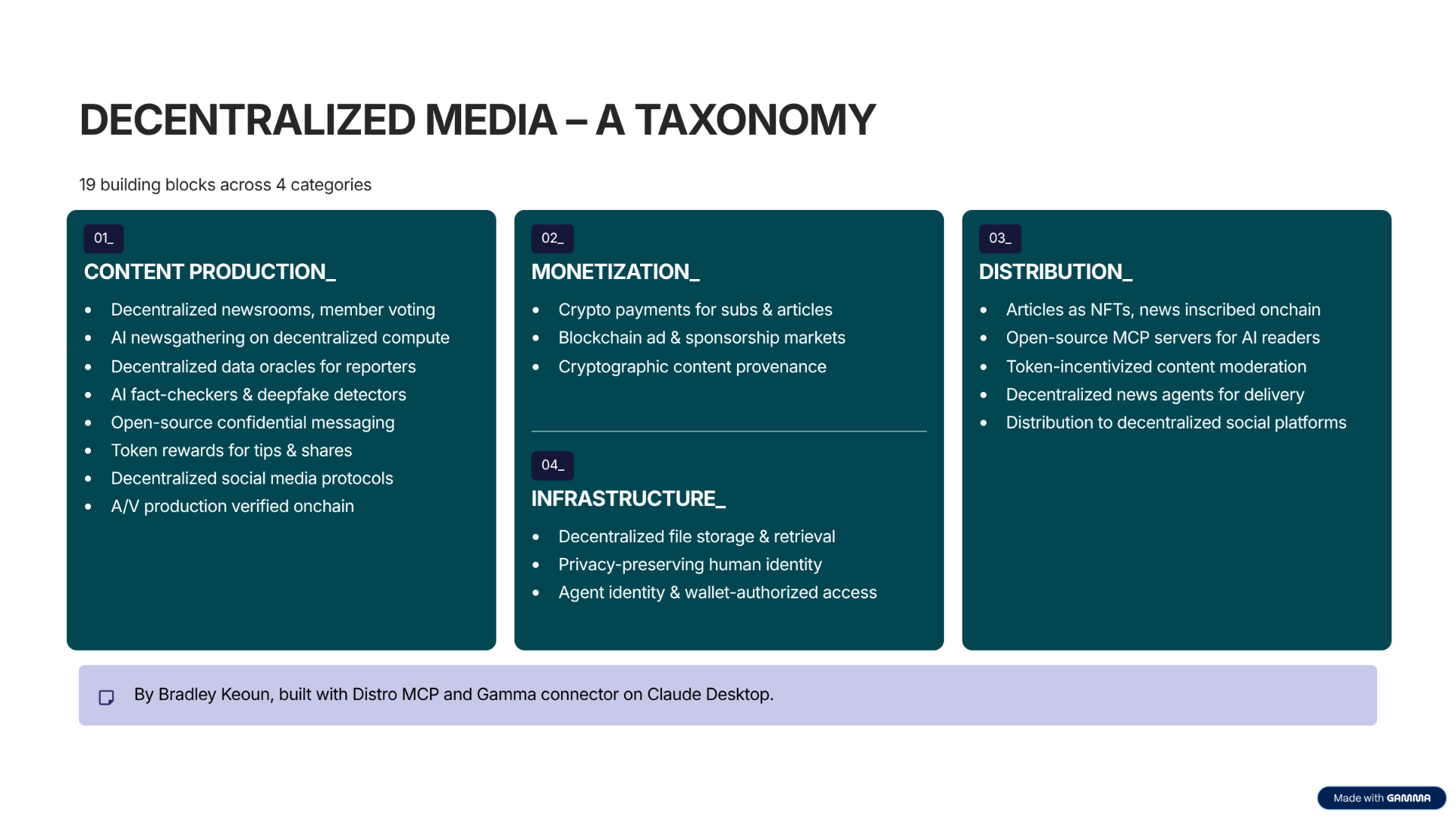
This op-ed by Distro Media founder Bradley Keoun initially appeared in the March 27 issue of the Association of Cryptocurrency Journalists and Researchers newsletter. A link to the original appears at the end of this reprint.
Mention the term, "decentralized media," and you're likely to get either blank stares or eye rolls.
Most normies would have no idea what that even is. A lot of veteran crypto journalists would say it's been tried, and it never works. Several of the most notable attempts to create blockchain-based media projects have shuttered or faded fast. Most crypto websites are Web 2 — just regular websites hosted on centralized servers.
And yet, there is a group of optimistic journalists and technologists who are actively exploring whether decentralization, broadly defined, could address news-industry challenges that seem to be growing more acute by the day.
At its core, decentralized media refers to the idea that we could improve the quality of media and news content, and the reliability of distribution, by eliminating single points of failure and reducing reliance on centrally-controlled companies. The theory is that peer-to-peer networks, community governance and blockchain tools could help to address daunting issues like censorship, trust in media, AI slop detection, source protection, data privacy and even operational resilience (such as trying to get the news out in the midst of an Internet blackout or power outage).
Content monetization could also be a natural fit: Could blockchain-based payments help journalists earn a decent living? Newsletter platforms like Substack might be considered decentralizing technologies, since they lower the bar for entry, allowing individual journalists or small teams to reach audiences directly, without the infrastructure and support of a centralized news organization. (H/t to Brazil Crypto Report's Aaron Stanley for this concept.)
Once you open the door to experimentation, the possibilities quickly get interesting. One project, Leviathan, has developed a decentralized news curation service, with its own mini economy where advertisers and sponsors pay for spots using a native crypto token, and rewards get paid out to contributors who submit relevant stories to share. The feed definitely leans degen, but it's quite sharp, timely and voluminous. The advertising-inventory auctions have consistently drawn strong bids.
There isn't much to lose from trying new ways of doing things, with so many newsrooms suffering severe financial challenges and reporters getting laid off en masse. Page views on news sites tumbled in 2025 as more user searches went straight to AI summaries, typically with minimal click-through rates and scant compensation, if any. Concerns are growing over alleged government censorship and media harassment, and the credibility of earnest news reporting is routinely called into question.
Many news outlets have tried to reduce their dependence on SEO and web hits, pivoting toward newsletters, short-form vertical video and shares on third-party social media platforms, while also embracing AI tools as a way to increase efficiency and productivity. Decentralization could be another path.
Rabbit hole
My own journey down the decentralized media rabbit hole began in early 2024, when I was managing editor of tech and protocols at CoinDesk, examining the system architecture of blockchain projects on a daily basis, and wondering why, as a crypto news site, we were still operating as a regular old web page — not eating our own cooking, one might say. Our page views were tanking, and I got the sense that it was not a priority of our new owner to invest in the newsroom, or to brainstorm ways of improving our distribution, or even to safeguard our editorial integrity for that matter.
So I quit my job, determined to explore the idea of building a decentralized media protocol. In December 2024, I founded Distributed Media Technologies Corp., a.k.a. Distro Media. It's a registered corporation in the state of Texas, not at all decentralized at the moment.
That same month, I met Zack Guzman, founder of Brooklyn-based Coinage, which is technically a cooperative registered in the state of Colorado, but is effectively a decentralized news organization: You buy a non-transferrable NFT, and then you can weigh in on the editorial decisions in their closed Telegram channel and vote on various issues.
I mentioned to Guzman that at some point we should try to arrange a confab of builders in this space; he liked the idea, so along with a group of fellow planners, including the Decentralized Storage Alliance's Valeria Kholostenko and ACJR's Joyce Hanson, we co-organized a "Decentralized Media Summit" at ETHDenver in February 2025. The event drew more than 60 attendees, featuring speakers including Guzman, Civic Media's Christine Mohan and The Defiant's Cami Russo.
This successful gathering birthed the Decentralized Media Network Telegram channel, where about 150 members now collaborate daily in discussions over the future of news. (Please join us! It's a mostly shill-free zone where all we do is talk about this kind of stuff. An invite link is here.)
Taxonomy in progress
Which brings me to this piece. We wanted to lay out a framework for thinking about decentralized media. As far as I know, there isn't really a body of research literature about decentralized media; nor is there any sort of formal industry group nor any official list of relevant projects or technologies.
So, here in the spirit of making a start, is the taxonomy of projects so far. January Jones, a former journalist who is now co-host of Hot Topics at Edge of Show, provided valuable input and feedback. We would love to hear from interested readers or builders, or from actual researchers who want to go deeper.
Please note: that there are a lot of news tools in traditional media being developed to make use of AI's data retrieval and analysis capabilities, or AI newswriting; a lot of these could theoretically be powered by so-called decentralized AI, where the LLMs are running on token-incentivized decentralized networks for GPU rentals and sharing.
The list:
Content production:
Decentralized newsrooms where members vote on editorial direction
AI agents for newsgathering running on decentralized compute networks
Decentralized data oracles updating reporters' analysis
AI fact-checkers, plagiarism and deepfake detectors to make sure it's real!
Open-source messaging to bypass data hosts and assure confidentiality
Rewards incentivizing a community of users to share news, videos and tips
Decentralized social media protocols
A/V production powered by decentralized AI and verified onchain
Monetization:
Crypto payments for subscriptions, individual article purchases, etc. Could be a distributed self-serve content marketplace, coordinated via AI agents
A blockchain-based version of Google AdSense, or automated blockchain markets for self-serve sponsorship sales
Content provenance in which every piece of content should be verified with cryptographic proof
Distribution:
Articles as NFTs; important news inscribed on blocks
Open-source MCP servers to let users read articles using whatever AI platform or agent they prefer
Decentralized incentivized (token-based) content moderation
Decentralized news agents for delivery and discovery, powered by decentralized AI
Decentralized social-media management platform distributing to decentralized social-media platforms
Other:
Decentralized file storage and retrieval
Privacy-preserving identity management to prove you are human and enabled to publish
AI agents with decentralized identity to prove they're eligible to retrieve articles from a decentralized news archive, and cover the cost with an authorized crypto wallet
Here is the link to the ACJR newsletter where the op-ed initially appeared: