AUSTIN, TX — Distro Media, a startup focused on news distribution in the AI era, announced Friday it has successfully activated a new type of editorial agent that could assist journalists in newsgathering, production and newsroom operations without the risks and elevated costs that come with reliance on centralized tech firms.
“We believe this is the first agent of its kind to run on a decentralized system and could provide a model for how agents can be sustainably and reliably integrated into newsrooms,” said Bradley Keoun, Distro’s founder and CEO.
The agent, JournoBot, was built expressly to support the editorial operations of Distro Media. That meant it had to be separate from our corporate agent launched earlier this year, DistroBot – to adhere to the principle that newsrooms should be walled off from corporate operations, preserving editorial independence.
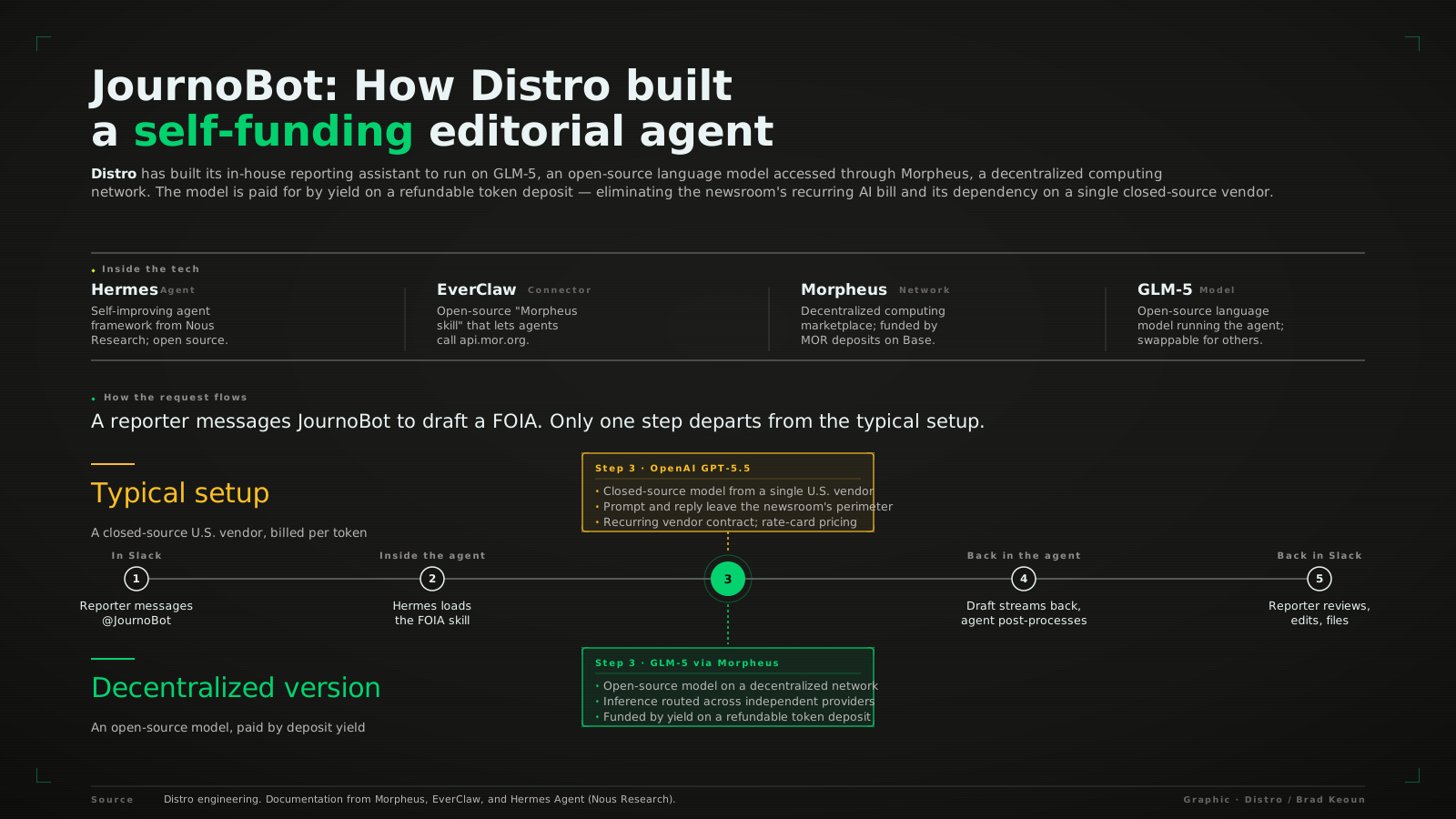
JournoBot’s engineering relies heavily on Morpheus, a decentralized AI network, along with EverClaw, a skill developed by Morpheus contributor David Johnston. EverClaw makes it easy to connect AI agents to Morpheus, which in turn makes it possible to run open-source AI models over a decentralized network of computers.
The goal of decentralized AI projects like Morpheus is to reduce dependence on big AI firms like Anthropic, the maker of Claude, or OpenAI, the maker of ChatGPT. As AI has become increasingly popular, users have had to constantly adapt to service outages at these firms along with changes in pricing plans and terms and conditions.
“We learned the hard way from our experience with DistroBot how annoying it is to be so dependent on these centralized AI providers,” Keoun said. “I do truly love using Claude, but as they became the default option for a lot of AI agents, the outages were increasing in frequency, which disrupted our operations at Distro. Then they changed their terms to make it impossible to run DistroBot off of a Claude subscription. We realized we couldn’t rely on them.”
JournoBot was built by Keoun and Agentic Insights founder Vaskin Kissoyan, who serves as Distro’s lead technical advisor. January Jones served as our strategy and communications advisor.
(Editor's note: for a series of diagrams showing how JournoBot works, please see our technical explainer here.)
JournoBot’s technical specifications:
Hermes open-source agent framework. (DistroBot was built on OpenClaw)
EverClaw to connect the agent to Morpheus decentralized inference. (Inference is the job of processing AI requests on computers.)
Morpheus Inference API to pay for the costs of processing user requests on open-source AI models like GLM-5 and Kimi 2.5.
Morpheus Marketplace API Builders Subnet to route staking rewards to pay for the inference, and in that sense, it's self-funding. (We staked 50 MOR, which so far has been yielding about $0.15 a day of staking rewards, and we have backup credits if we burn through that amount.)
Installed in a dedicated Slack channel that theoretically would be isolated from commercial or corporate-wide channels and intentionally walled off from our corporate agent, DistroBot.
Initially, JournoBot will be used to support Distro’s in-house publications, including DeAI News and Liqquidity’s Newslode. Tasks could include background research, spell checks, style checks, fact checks, search engine optimization (SEO), answer engine optimization (AEO), writing social posts, content scheduling and distribution tasks. In the future, we would have JournoBot writing drafts of Freedom of Information Act requests and track responses. Theoretically, JournoBot could also write first drafts of articles, but with caution and subject to human approval and accountability.
After testing, if JournoBot is meaningfully successful as a newsroom assistant, we may offer to set up Distro publishers with their own agents, as a service.
“We are investing now to figure this out, in hopes that our experience will eventually prove useful and valuable to other journalists and Distro publishers,” Keoun said. “A lot of newsrooms are experimenting with AI, but we highly doubt anyone else is using decentralized AI to power their agents. We do think that this will eventually become standard operating procedure, so we’re pleased to pioneer this new way of supporting independent journalism.”
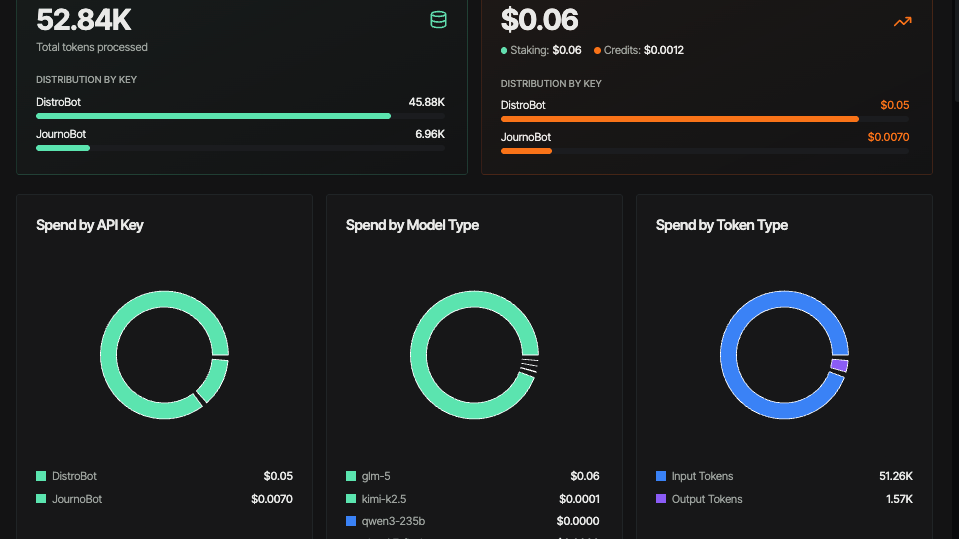
Screenshot of Morpheus Inference API dashboard showing JournoBot's usage and staking credits. Note that we also briefly ran DistroBot on the setup. (Bradley Keoun/Morpheus)
About Distro Media:
We're an Austin-based startup, founded in 2024 by former CoinDesk and Bloomberg journalist Bradley Keoun. We build AI- and blockchain-based tools for publishing and distributing news and content.
Distro's platform consists of a consumer-friendly web app and news database, in combination with our Distro Publisher and Distro Reader MCP servers. The setup allows reporters to publish their work on their own online publication, or several. Importantly, it allows their stories to be delivered in their original, non-summarized form to readers via their AI chatbots or agents. That's crucial, because we believe that in the not-too-distant future, most people will likely be getting most of their information via an AI agent or smart browser.
Our flagship web app, DistroVerse, lets anyone create a "newslode" in just a few clicks. A newslode is the AI-era version of a digital magazine, newspaper, or video album, and we hope that someday, a lot of people will be using one regularly – even if it’s not through Distro! – to express themselves and exercise their individual rights to freedom of the press.