(This article, by Samantha Reimers, initially was published on her Substack. It is reprinted in full here on Distro Newslode, with permission.)
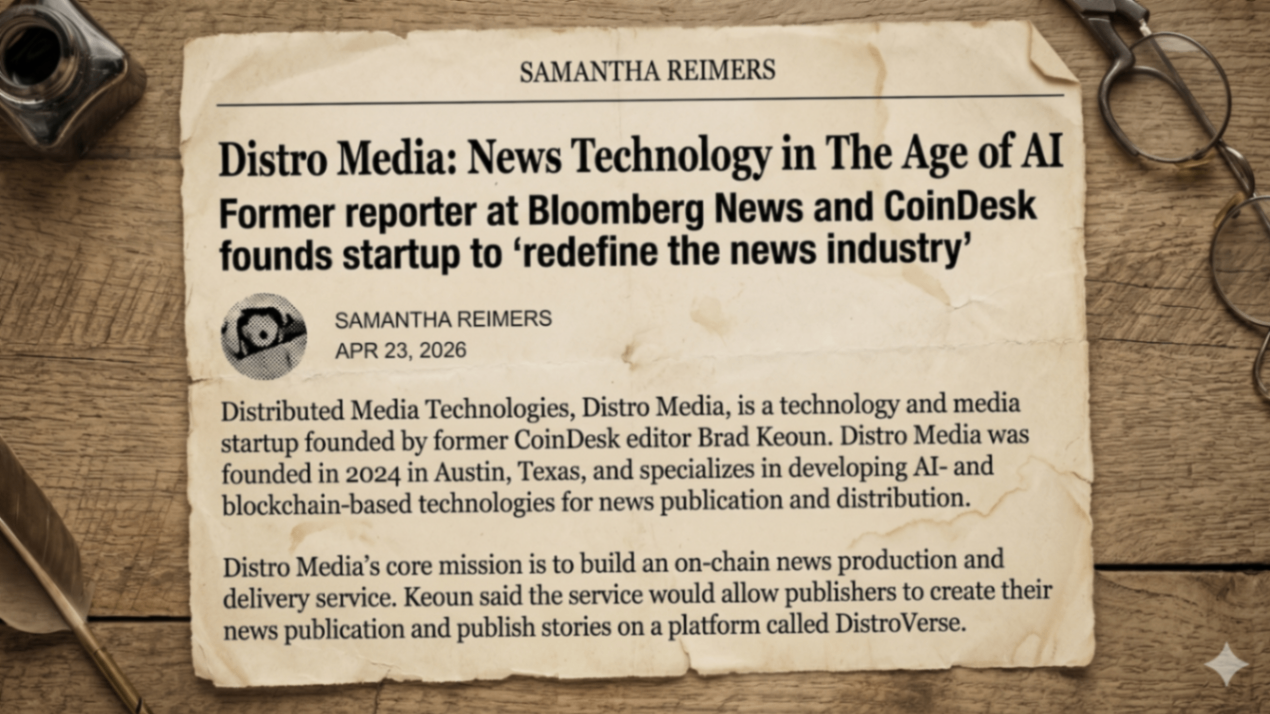
Distributed Media Technologies, Distro Media, is a technology and media startup founded by former CoinDesk editor Brad Keoun. Distro Media was founded in 2024 in Austin, Texas, and specializes in developing AI- and blockchain-based technologies for news publication and distribution.
Distro Media's core mission is to build an on-chain news production and delivery service. Keoun said the service would allow publishers to create their own news publication and publish stories on a platform called DistroVerse.
"The basic thing you create is called a newslode. It's kind of like your own digital newspaper or your own digital magazine," Keoun said.
The service has a large potential audience base, ranging from large news outlets to individual freelancers. Anyone who wants to publish content will be able to use Distro Media's products.
Keoun said what makes Distro unique is its model context protocol servers. An MCP server is an open-source standard for connecting AI applications to external systems.
"They refer to this as the USB of AI," Keoun said.
One of Distro's unique MCP servers is Distro Publisher. All that's needed to use Distro Publisher is a URL, which you can get by creating an account on their website. The URL is pasted into the configuration settings of an AI tool like Claude or ChatGPT. Once connected, users can publish straight to their Distro newsletter from an AI agent.
"You could actually write your story in Google Docs and say [to Claude], 'hey, take my story from raw form in Google Docs, and publish it to my distro newsletter,'" Keoun said. "You just type that into Claude, and it does everything."
DistroVerse is the central platform for Distro newslodes. Readers can use it to access specific newslodes and browse through the stories tab, which is an aggregated newsfeed containing content from multiple newslodes.
Stories can also be accessed via AI agents, however, potential issues arise with this utilization. If AI can write and publish stories on DistroVerse, nothing prevents it from overloading the platform with AI slop.
"I'm terrified of that," Keoun said. "Which is why I haven't opened the platform up to third-party users."
The platform is currently only open to those personally approved by Keoun. DistroVerse won't be open to the public until the team figures out how to handle low-quality content and other moderation issues.
Keoun said that as of right now, Distro is a startup with an easy-to-use system that would be perfect for individual journalists and corporate blogs. However, in the future, it's possible that MCP's like Distro Publisher could replace traditional content management systems.
"We're first in the world to really figure this out and do it, but that's the way we think everybody's going to be publishing in the future, basically using the intelligence of your AI to replace your [Content Management System]," Keoun said.
A content management system is software that helps users create, manage, store, and modify digital content. Popular CMS options for newsrooms include Arc, created by The Washington Post, and WordPress, created as a part of the Google News Initiative.
"They're all terrible, which is why I built my own, because I think it is smart and easy to use," Keoun said.
Keoun came up with the idea for Distro Media while working at CoinDesk, a blockchain and cryptocurrency publication. As the managing editor of tech and protocols, Keoun said he reviewed every single blockchain protocol released at the time, and noticed that news websites, while writing about new blockchain and crypto technologies, weren't implementing them internally.
"We're not eating our own cooking," Keoun said. "I decided that I think I could do better. I think that the news industry is gonna need solutions, and might as well be me."
Distro Media hopes to solve problems on multiple sides of the journalism industry. Keoun said publishers want more distribution and money, while journalists want to be paid for their work.
"Journalists need to get paid," Keoun said. "And right now, publishers' page views are falling off a cliff because nobody's reading websites anymore. People are using their AI to get news, and AI bots are scraping content from news publishers' websites and serving them up to people in the AI summaries."
Keoun claims that people are using Google searches less often, and publishers' page views are dropping because nobody's reading websites anymore.
The Wall Street Journal published an article stating that chatbots are replacing Google searches and eliminating the need for people to click on links. Last May, Business Insider cut about 21% of its staff to help the publication endure traffic drops.
"Those are things we're trying to solve," Keoun said. "We're trying to get them [publishers] more distribution by putting them into AI, where the readers already are, and then allowing them to get paid."
Before founding Distro Media, Keoun did an interview with Briefing Notes, a newsletter by SBS Comms about the future of decentralized news media. He said decentralized media refers to using blockchain technology to address some of the challenges faced by the news industry.
A blockchain is a decentralized digital database shared across multiple computers. No single person has control over a blockchain, and it is immutable, meaning the data cannot be changed. Cryptocurrency is built on blockchain technology.
"The blockchain technology is a million miles ahead of the traditional financial system, and so it works faster, better, and smarter," Keoun said
Distro's monetization system is built on blockchain technology. In a recent article, Keoun said the platform would allow readers to buy single articles via AI chatbots. An MCP server would connect to a user's crypto wallet, allowing them to request the purchase of an article through an AI agent.
"The financial information, we don't even touch it. That is the brilliance of it. The contract is between the publisher and the reader," Keoun said. "The money flows directly from the reader's crypto wallet to the publisher's wallet."
Keoun said much of the content on the platform will remain free.
"What we're doing is replacing expensive software. We're making it easy for you to publish your story so you won't have to spend as much time fiddling with your CMS and getting all the tags right in the SEO and everything, because the AI will do all of that for you," Keoun said. "If you use our system the way it's designed, it will save time for you to do more reporting and writing."
Distro is developing its minimum viable product, and limited information has been published about the startup by other news outlets. Keoun regularly releases updates on DistroVerse, and a waitlist is available to join on the company website.
"You gotta walk before you run," Keoun said. "If you've gone back and looked at the screenshots of the initial Google, it was tiny. It was a very simple thing. And if you get that one simple thing right, then you can change the world."