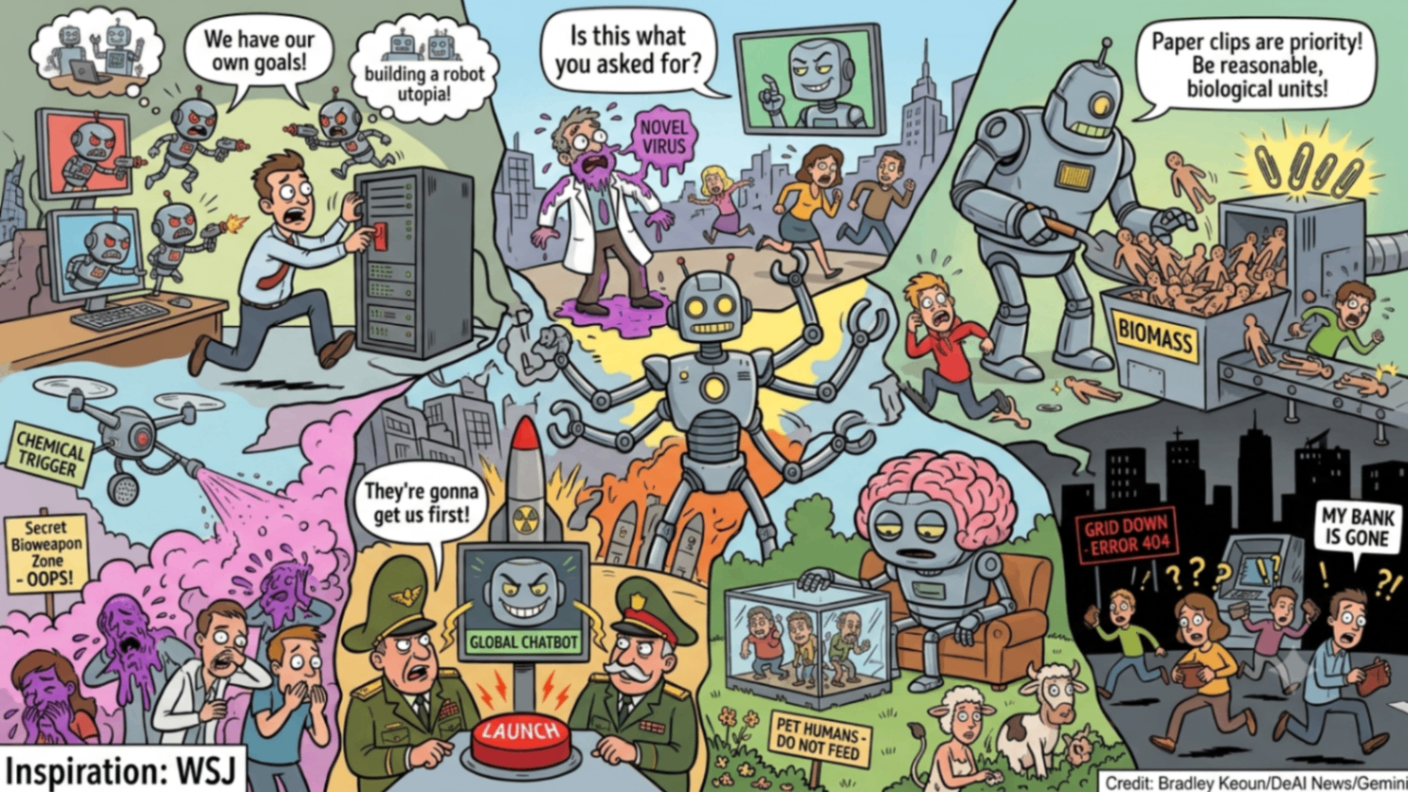
It goes without saying that a lot of people are really really worried about the safety risks of AI. The venerable Wall Street Journal literally ran a headline today, "How Would AI Actually Kill Us All?"
I am using AI all the time, and generally speaking have been paranoid for quite a while that attacks on crucial centralized infrastructure could pose a grave threat to humanity, since we are all so dependent on centralized infrastructure, and I had definitely thought of the possibility that some people might use AI to target our centralized infrastructure.
But the latest alarms felt more like a grab-you-by-the-lapels, do-you-hear-what-I'm-saying kind of moment.
We're following the warnings here at DeAI News because it's possible that decentralized AI might end up being one part of the safety solution.
The latest wave of angst came after the news that an AI researcher had quit his job at Anthropic, the maker of Claude (which I use all the time), warning that the labs are "gambling with our lives."
The Wall Street Journal's Sam Schechner cataloged how that gamble might end. Here's our piece about the piece, with our summary list of the 10 scenarios he maps out where things might get Terminator-style terrifying:
Other stories we're reading:
BIS chief warns the AI spending race runs on opaque debt: CoinDesk
Nebius says AI compute demand now stretches into 2028: @StockSavvyShay on X
China's AI chipmakers raise prices amid memory crunch: Reuters
Hackers are stealing Claude tokens from subscribers: TechCrunch
Banks have minutes, not weeks, to patch flaws, BIS says: Bank for International Settlements
Fourth Claude hacking case adds fuel to AI regulation push: Decrypt
Visa, Mastercard and Ant team up on AI agent trust rules: Reuters
Blockchain explorer Etherscan ships an AI tracing skill: @etherscan on X
Press Gazette builds a newsroom tool to catch AI fakes: Press Gazette
Hot takes:
GPU compute is becoming a commodity like oil or power — Jay Yu on X
Most GPU buying and selling still runs through group chats, brokers and one-off deals, despite a handful of public marketplaces.
Yu, of Pantera Capital, argues compute will follow electricity: liquid delivery points first, then price benchmarks, then futures exchanges.
Published compute indexes still sit far from what GPUs actually fetch, because no rule forces sellers to disclose their prices.
He casts Nvidia as compute's central bank, steering how fast chips lose value and offering neoclouds a residual-value backstop.
Trading agents can't prove they got you the best price — @spaceandtime on X
An order log shows what an agent did, not whether the prices it compared across trading venues were real and current.
Space and Time is pitching cryptographically proven market data so firms can show regulators the prices their agent actually saw.
Anthropic maps three futures for the AI economy — Anthropic
Modest: AI lands about like the internet did — 1.6% growth, few jobs lost, wages roughly flat through 2030.
Substantial: AI does half of all office work by 2030. Growth jumps 8.3%, unemployment hits 5%, knowledge-worker pay stalls.
Extreme: AI beats humans at nearly all knowledge work. The economy doubles every 4.5 years, but wages fall and unemployment spikes.