EDITOR'S NOTE: I conducted an agentic coding session with Claude CLI – an AI coding agent – in Visual Studio – a code-editing platform – and then asked Claude CLI to write an article about it from the perspective of an omniscient narrator. So I (Brad, the human user, doing the agentic coding) would be a character in this narrative, and Claude CLI would be another character. I provided some instructions to Claude CLI on how to write the piece (the tone/style etc.), and then I provided feedback on a few drafts/iterations, similar to the way an editor would provide feedback to a reporter. Once I was mostly satisfied, I asked Claude CLI to use Distro CLI + the Distro Publisher MCP server to file a draft to Liqquidity's Newslode, and then I used our editing interface here in DistroVerse to make some final tweaks, upload an image and then publish the piece, and social it using our native share button. I have fact-checked all of this and attest that it is accurate. All of this is done in the spirit of building in the open and demo'ing Distro's capabilities as the original agentic press.
The gap between patching software and rebuilding it properly has narrowed to almost nothing.
For a founder building in May 2026, the right answer is increasingly to do it the way it should have been done the first time.
A small recent episode at Distro, an early-stage content platform, shows how quickly the calculation has shifted.
Distro hosts a number of independent publications, including DeAI News, which covers the meeting point of cryptocurrency and artificial intelligence. The platform exposes its stories to outside chatbots through a piece of software called the Distro Reader MCP. (MCP, for Model Context Protocol, is the emerging standard that lets AI assistants reach into third-party services. Distro Reader gives any chatbot a way to ask Distro for headlines and pull up full articles.)
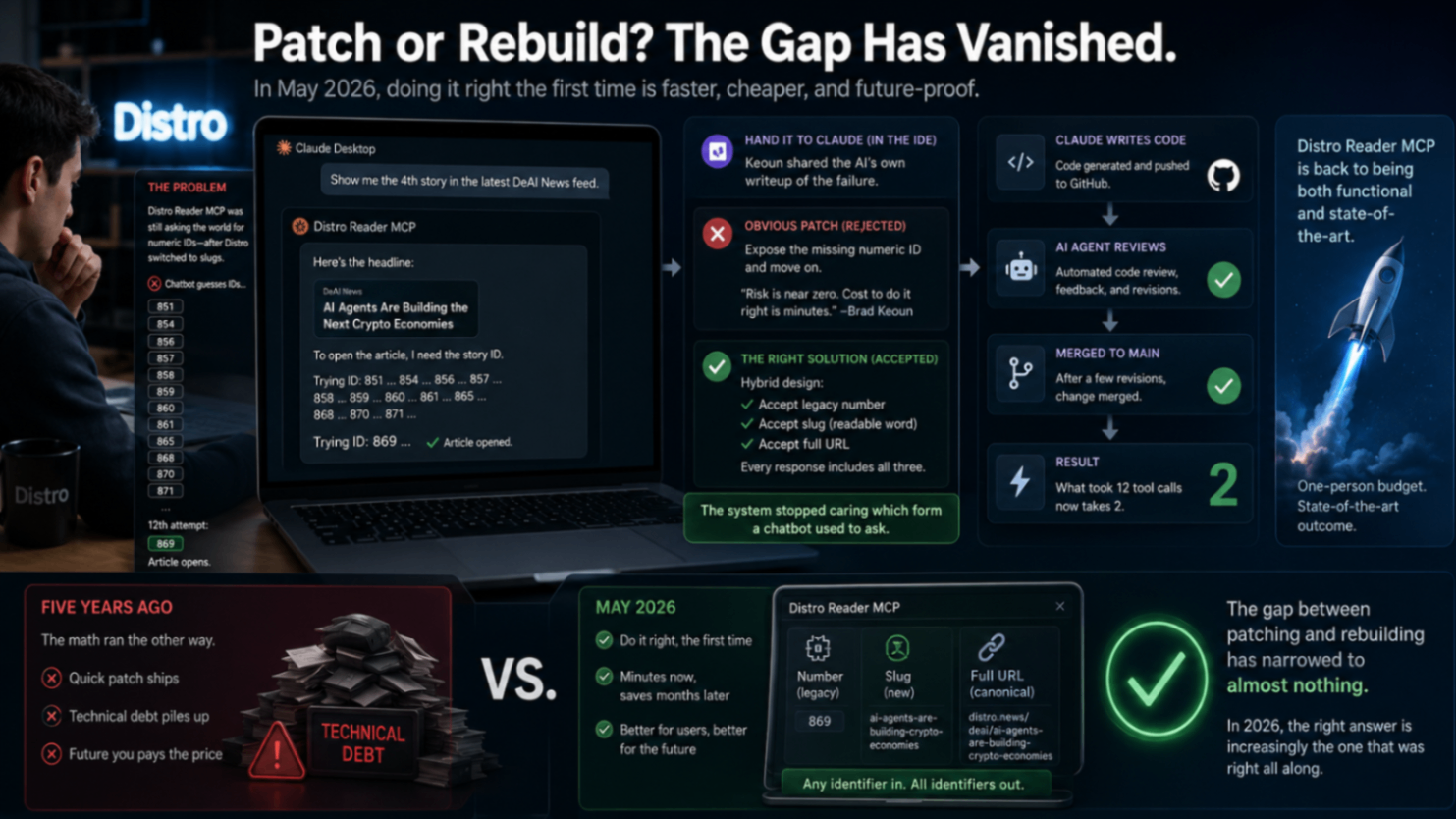
Distro's founder, Brad Keoun, was testing the reader himself when he asked the assistant on his laptop, an instance of Claude, for the fourth story in the latest DeAI News feed. Claude produced the headline. To open the article, though, it needed Distro's internal numeric ID for the story, which the feed did not return. So Claude began guessing: 851, 854, 856, 857, 858, 859, 860, 861, 865, 868, 870, 871. On the twelfth attempt it tried 869, and the article opened.
The cause was unglamorous. Distro had recently switched its public web addresses from numbers to readable words, or "slugs," a convention most websites use. The reader software, written before the switch, had never been updated to recognize the new format. The chatbot was still asking the world for numbers.
Keoun took the AI's own writeup of the failure and handed it to a different Claude, the one running inside his coding tools. The first recommendation was the obvious one: expose the missing numeric ID in the responses and move on. He turned it down. Distro has almost no users yet, he reasoned, which means the risk of a deeper change that might upset users is near zero. Plus, his AI coding subscription comes for a flat monthly fee, so the marginal cost of doing it properly was effectively minutes of his time.
The coding assistant returned with a hybrid design. Every story would now answer to any of its identifiers: the legacy number, the new word-based address, or the full link. Every response from the reader would carry all three. The system stopped caring which form a chatbot used to ask.
Claude wrote the code and sent it off to GitHub, a software-management platform where the project's definitive programming is stored. A separate AI coding agent reviewed the new contributions, and after a few revisions, the change was added to the main codebase. The request that had taken 12 tool calls in the morning now took two.
Five years ago, the math would have run the other way. The patch would have shipped, and the technical debt – code that, in hindsight, should have been done differently – would have piled up behind it.
On a one-person budget in 2026, neither happened, and now the Distro Reader MCP is back to being both functional and state-of-the-art.
EDITOR'S NOTE: This story was originally published on Liqquidity's Newslode. The original is here.