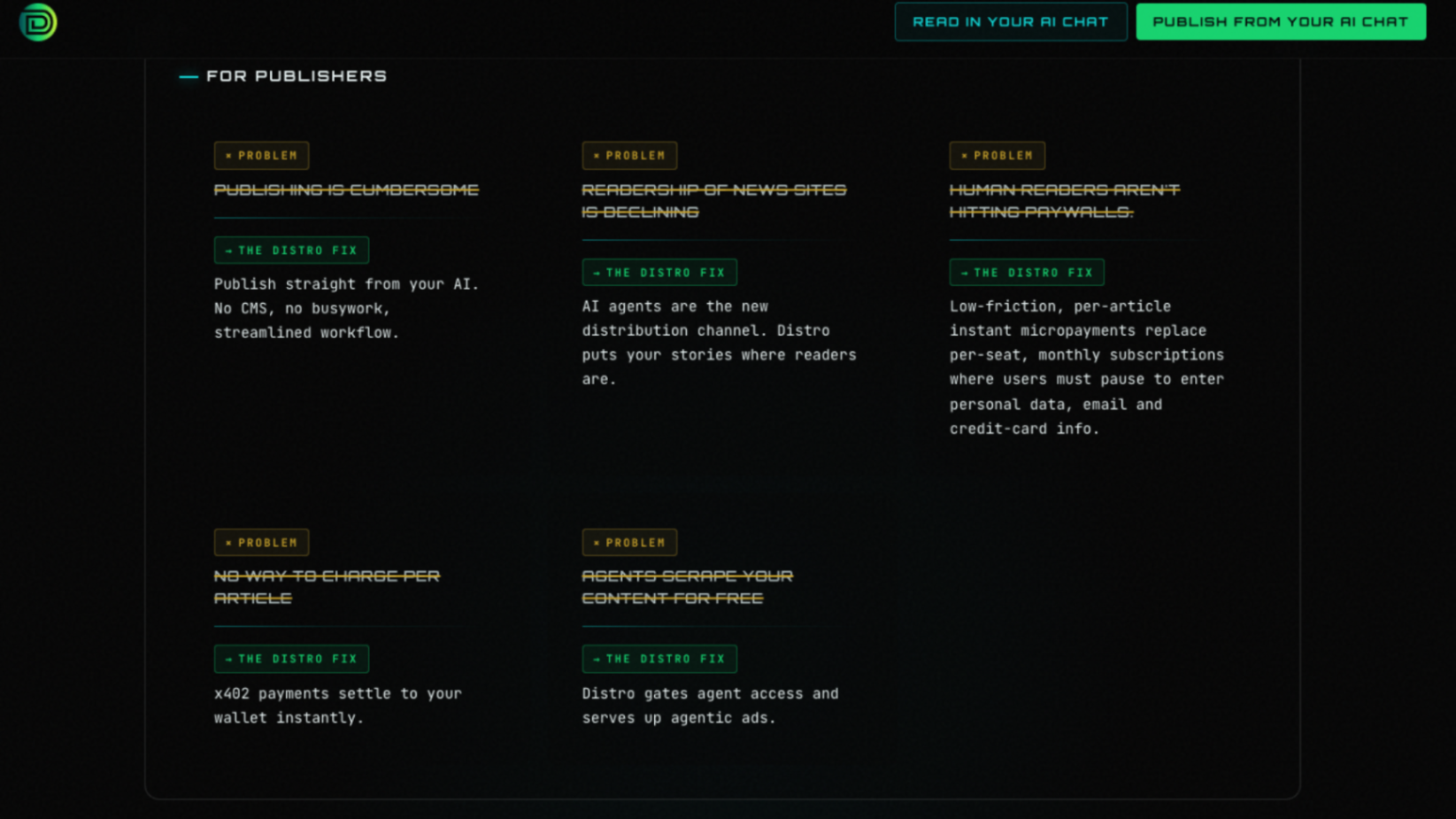
Until this past weekend, our websites didn’t do a good job of telling you who we are.
If you visited our corporate site at distro.media, you would have had a hard time discerning our mission, our vision, the tech we’ve built, or the problem we’re solving. The navigation wasn’t straightforward, and it wasn’t clear what we wanted you to actually do once you got there.
Meanwhile our web app had a different problem: plenty to read, but zero identifying information about what Distro is or who is behind it all, and not a single link back to the corporate site.
So we spent an afternoon plugging away at the dual issues on Claude Code, and now things are looking a lot better.
One takeaway: If your app is built with agentic coding, and your setup is structured for fast progress with easy updates and a smooth pipeline for deploying changes, there's no point in delaying improvements that may have been quietly bothering you.
Starting with a PRD
We had redesigned our corporate website earlier this year, when we moved off a design created in 2025 by our intern on Framer, and realized we could save money by spinning up a clone using AI coding tools, and hosting it ourselves.
But since then, our tech has come a long way, and our strategy has evolved, becoming a lot clearer on what our value proposition actually is.
We are now moving to begin inviting in users and collaborators and potentially also investors, and we wanted to present a more cohesive view on our public-facing materials of what we actually do.
I assigned Rutvik Choksi, a Consensys vet and product-management expert who is working for us as a consultant, to take a look at both our website and the app, and to come up with some recommendations on how to harmonize everything.
Rutvik came back with a finished product requirements document (PRD) late last week, essentially a dossier of all of the changes he was recommending. On Sunday, I asked Claude Code to take a shot at reconciling Rutvik’s PRD with the reality of our codebase.
I asked Claude Code to refer to the project as "Harmony."
Then some research
Before planning anything, I asked the AI to read the code of both websites and compared what it found against the PRD, point by point. Most of what it learned, I already was basically aware of: The app didn’t just lack a link to the corporate site; it had no footer at all, on any page. The only links tying our two properties together were buried on the sign-in screen.
I invoked the brainstorming skill on Claude Code (highly recommend if you haven't tried it), and the machine came back with a comprehensive plan, leaning on a few core marketing principles. Give each website one job: The corporate site explains and persuades, while the app stays a clean reading surface. Lead with the reader’s problem, not your features; our new homepage opens with the problem we exist to solve. And keep the story of who you are in one canonical place, with everything else pointing at it.
By dinner we had a rebuilt corporate site. This included a new opening sequence (closely resembling Rutvik's suggestions), a homepage that says what we do, pages for our history, our privacy policy, our founder’s background, and one hub for all the AI-connection instructions. The app finally got its footer – designed so a first-time reader landing on a shared story can find out who we are. Google’s automated scoring gave the new site 95 out of 100 for speed on phones and 100 for accessibility.
This is the part of agentic coding that keeps sinking in for me. As your strategy evolves and new audiences come into view, going back to add a major building block your app never had, or rebuilding your primary corporate website in an afternoon, is now a realistic ask.
There's no longer any excuse to procrastinate.
(HOW AI WAS USED IN THE PRODUCTION OF THIS PIECE: I asked AI to write the first draft of this article, relying on the transcript of my coding session within Claude Code inside Visual Studio and a custom skill I developed to replicate my own writing style. Then I used Distro Publisher, our official MCP server, to file the story as a draft directly from Claude Code to my newslode. I then edited the draft in DistroVerse’s editing interface and checked all the facts before publishing.)